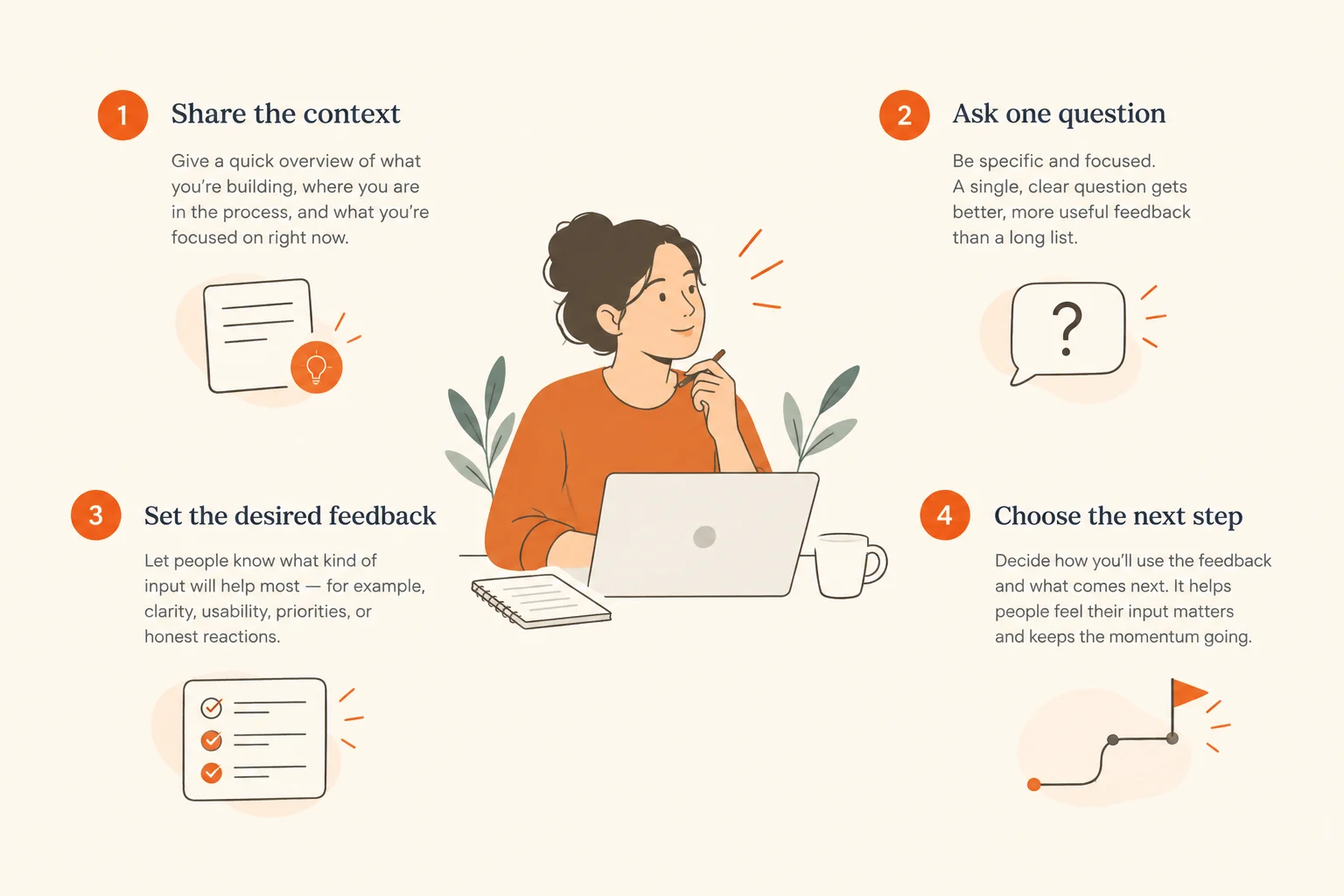
Founder networking works better when you give people brief context, ask one question they can answer, name the kind of feedback you want, and explain what you’ll do with it. That gives another founder a manageable way to help. It also keeps the decision where it belongs: with you.
Why is “Any advice?” hard to answer?
“Any advice?” sounds friendly, but it leaves most of the work with the other person. They have to guess whether you want help with your product, customers, pricing, or something else. If they know little about your company, they may offer general advice you’ve already heard.
A broad question can work in a relaxed conversation with someone who knows your business. In a founder community or a first meeting, start narrower. Someone can then judge whether their experience applies, and you can tell what to do with their reply.
Being connected to founders doesn’t mean you’ll receive useful help. In a study based on interviews with 26 founders, researchers found that participants extracted few resources beyond information from digital networks. They identified perceived social judgment risk as one reason. The published abstract doesn’t test how to word a feedback request, so it can’t prove that a narrower question will get better replies. It does show why access to a network shouldn’t be confused with a useful exchange.
What context does another founder need?
Give the smallest amount of context that makes your question answerable: the customer, the decision in front of you, and the observation or constraint behind it. You’re showing someone which part of your thinking you want them to examine, not presenting your whole company.
For example, “I’m building software for independent accountants” identifies an audience. “I’m deciding whether to show prices before a demo” names the choice. “Prospects keep asking about cost in their first email” explains why it matters, if you’ve actually observed that. Those details give someone more to work with than “How should I grow?”
Leave out the company history unless it changes the answer. People can ask for more detail. In a public post, remove customer names and identifying details you don’t have permission to share. You can explain a decision without exposing someone else’s conversation.
Think about whose perspective you need, too. A founder who has sold to accountants might recognize a pricing tradeoff. Someone outside that market might notice that your question assumes every buyer wants a demo. Both could help, but they’re examining different parts of the problem.
Who it’s for: Name the buyer or user in plain language.
What you’re deciding: State the choice, not your entire strategy.
What you’ve seen: Include one relevant observation, and keep guesses separate.
What limits the choice: Mention a deadline, budget, or other constraint if it affects the answer.
How do you ask one question people can actually answer?
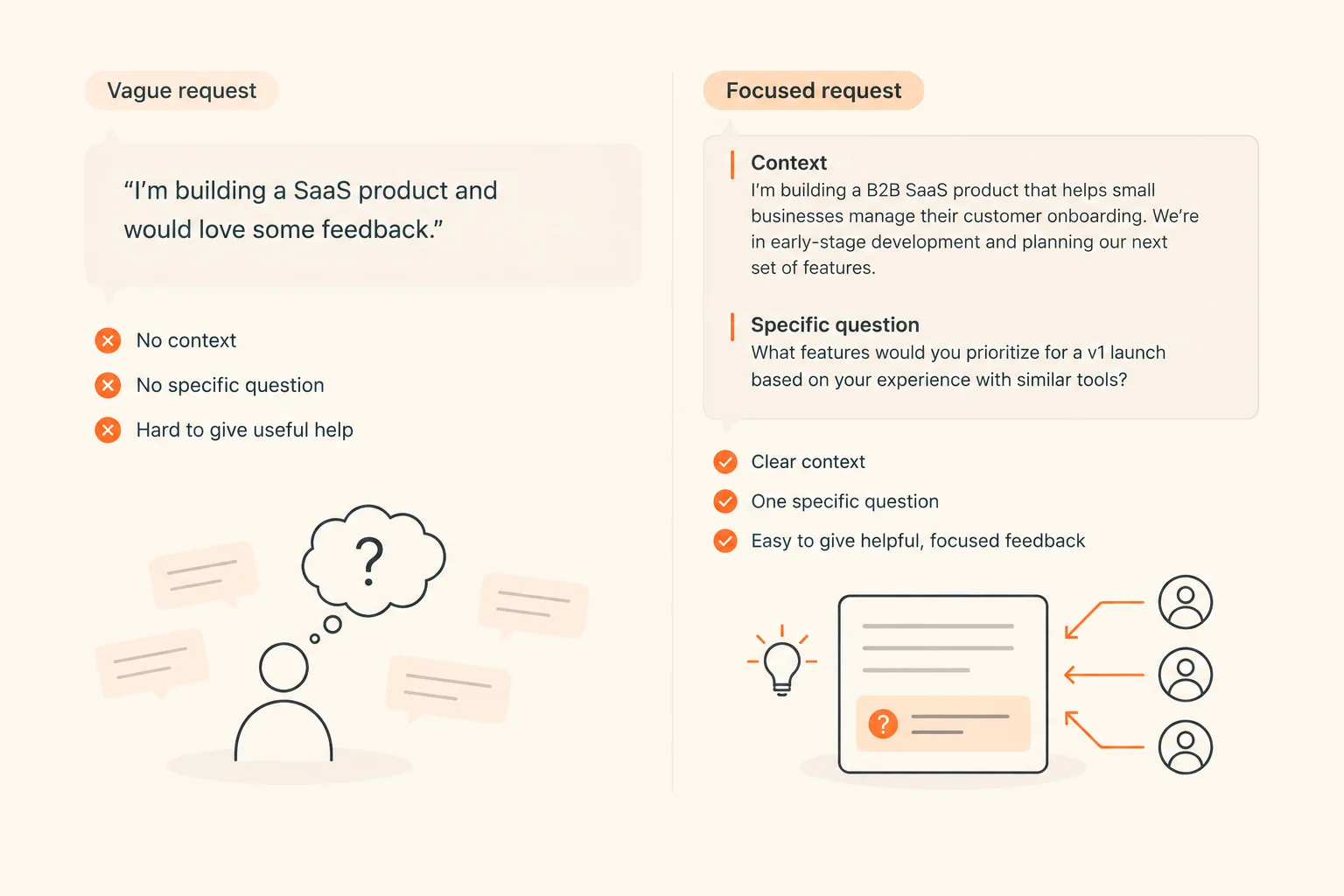
Ask about a choice, a point of confusion, or a piece of work someone can inspect. “Would you put pricing on this page before the demo request, and what would make you choose differently?” gives a respondent a clear job. “Thoughts on my startup?” doesn’t.
Decide what kind of feedback you need before writing the question. A quick reaction can tell you what seems unclear. An example can show how someone handled a similar choice. A challenge to your reasoning can expose an assumption you missed. Asking for all three, plus a review of the business, turns a short exchange into an open-ended consulting request.
Watch for wording that invites agreement. “Don’t you think we should add pricing?” points people toward your preferred answer. “What would a buyer need to know before pricing helps them?” leaves room for disagreement. You want a reply you can learn from, including one that complicates your plan.
Match the effort to the setting. A public post might invite reactions to two short headlines. A detailed review of your sales process deserves a separate conversation with someone who has agreed to spend that time. In Stephanie Hurlburt’s guide to networking for founders, direct asks sit alongside helping others and following up. Be clear about what you need while respecting the person answering.
What does a focused feedback request look like?
Here’s a hypothetical example, not a customer story or a result from Buildside. Imagine a founder building a scheduling tool for small design agencies. They’re deciding whether to lead their landing page with calendar coordination or approval reminders.
The vague request is: “Launching my SaaS soon. Any advice on the landing page?” There’s no intended reader, no copy to inspect, and no decision for another founder to weigh. A respondent has to guess at the problem.
A more useful request is: “I’m building a scheduling tool for small design agencies. I’m choosing the first message on the landing page: fewer calendar emails or fewer missed client approvals. I’ve heard both problems in early conversations, but I don’t know which is clearer to a new visitor. If you’ve sold to agencies, which would you test first, and what would change your mind? I’ll use the replies to choose one version to show prospects.”
The request asks for help choosing a next test, not a declaration of the winning message. Other founders may spot weak reasoning or suggest a clearer way to frame the choice. Prospective buyers still need to see the message before the founder can learn how they respond.
If the founder has already written two headlines, sharing the exact wording would make the question easier to answer. If they haven’t written either one, drafting them may be the useful first step. Give people something specific to react to.
Where should you make the request?
Choose a setting that fits the question rather than copying the same post into every founder group. A public build-in-public update works when the choice is easy to describe and you want several perspectives. A private conversation fits a sensitive decision or a question for someone with closely related experience. At an event, back-and-forth can help when you’re still trying to define the problem.
Communities and programs offer different ways to have those exchanges. Founders Network describes a tech-founder mentoring community with a forum and events. Founder Institute describes a company-building program that includes mentor feedback. Those are descriptions of what each offers, not evidence that either will give your question a better answer. Look for relevant experience and a format in which you can provide enough context.
If you’re building in public, a progress update can carry the ask: say what changed, then explain the choice you’re working through. Someone following along can see why you’re asking now. You don’t need to attach a request to every update. Sharing what you learned or answering another founder’s question gives others something useful as well.
Check a community’s rules and tone before posting. In a space for discussing lessons, a bare product link followed by “thoughts?” may read as promotion. Explain the decision in the post itself, so people can respond without first visiting your site.
A useful example is the Midwest Founders Community’s participation principles, which ask members to be constructive and recognize what each person brings. Apply that standard to your request: invite a different view, explain what you can act on, and respond respectfully when someone challenges your assumption.
How do you use answers without outsourcing the decision?
Read replies for reasons, not votes. If several founders prefer one option, ask what they assumed about your customer. Their reasoning might reveal a detail you left out or a question worth putting to buyers. A confident reply from someone serving a different market may still challenge your thinking, but it isn’t proof that their approach fits yours.
Sort what you hear into three categories: something you can test, something you need to investigate, and something that doesn’t fit your current constraints. This gives you a way to handle contradictory suggestions without treating every reply as an instruction.
Close the loop when it’s natural. Thank the person, say what you decided, and share what you’ll check next. If you chose another path, you can still say what their comment made you reconsider. Hurlburt’s networking guide includes courtesies and follow-ups as part of maintaining relationships. Following up doesn’t require you to agree.
Keep the update as precise as your evidence allows. “We’re showing the shorter headline to prospects next week” reports a decision. “Your advice increased conversions” would require measured results. You can share an honest update before the test has produced an answer.
Test: “I can show both messages to prospective buyers.”
Investigate: “I need to learn when this objection first comes up.”
Set aside: “This suggestion assumes a sales team we don’t have.”
What short template can you reuse?
Use this when you have a real decision to make. It’s a drafting aid, not a script. A conversation may need only two sentences; a public post may need enough context to stand on its own.
“I’m building [product or service] for [specific audience]. I’m deciding between [option A] and [option B] because [relevant observation or constraint]. If you’ve dealt with [related situation], what would you consider before choosing? I’m looking for [a reaction, an example, or a challenge to my reasoning]. I’ll use the feedback to [next step].”
Before sending it, cut anything that doesn’t help someone answer. Check that the observation is something you know, not a guess presented as fact. If you can’t name a next step, decide what you’re trying to learn first. Then ask the question you’re ready to use.
Next step
Building in public and looking for a place to share progress with other founders? Explore Buildside and start a free trial. Bring one decision you’re working through and try a focused feedback request.
References
- Founders' uses of digital networks for resource acquisition: Extending network theory online
- Networking for founders
- Founders Network • Startup mentorship, peer to peer forums, connect with entrepreneurs and investors
- Founder Institute, World's Largest AI-Native Company Builder
- Midwest Founders Community